Rochester, New York, 5/25/26 - Buying supplements on sale is a straightforward idea: if you use something regularly and the price drops, stocking up makes sense. A few things are worth thinking through first: whether the product has enough shelf life for the quantity you plan to buy, how you plan to store it, and whether your routine is stable enough to justify a larger purchase. When those answers line up, the savings are real and the logic is simple.
Supplement sales (whether they take the form of a straight discount, a buy-2-get-1-free structure, or seasonal pricing) show up regularly across the market. Knowing how to evaluate them takes less effort than most people expect.
Why Supplement Sales Are Worth Paying Attention To
Supplements sit in an unusual category for household budgeting. Unlike groceries that turn over quickly, vitamins and minerals are shelf-stable for long periods when stored properly. Unlike electronics or clothing, the product you buy on sale is the same product at full price. There is no compromise in choosing supplement deals over full-price purchases from the same brand.
That combination of consistent personal demand and durable shelf life is what makes buying supplements on sale a planning move worth considering. For people who already have a steady supplement routine, a sale offers a direct reduction in cost per dose with no meaningful downside. The savings are proportional to how much you buy and how reliably you will use the supply before it expires.
For people still experimenting with what works for them, the logic is slightly different. A sale is less compelling for a product you are not yet sure you will stick with, because a large unused supply is not a deal. It is a sunk cost. The right time to stock up is when the routine is already in place and the question is simply how much to order at once.
Do Vitamins Expire? Understanding Supplement Shelf Life
One of the most common questions people have when considering larger supplement purchases is whether vitamins expire, and what that expiration actually means. Most supplement labels carry a "best by" or "use by" date. That date reflects the manufacturer's guarantee of full labeled potency under specified storage conditions, not a safety cutoff in the way food spoilage works.
The NIH Office of Dietary Supplements notes that supplements are expected to contain ingredients at the amounts listed through the end of their labeled shelf life when stored correctly. The FDA similarly requires that manufacturers substantiate that products meet label claims for identity, purity, strength, and composition through the expiry date. In practice, most vitamins and minerals may remain stable well within their labeled date when kept in cool, dry, dark conditions.
How long vitamins last depends on the specific nutrient, the delivery form, and storage conditions. Fat-soluble vitamins such as A, D, E, and K and some B vitamins may be more sensitive to heat, light, and oxygen than others. Water-soluble vitamins generally hold up well when packaging stays sealed. The supplement expiry date on the label is the clearest reference point: buying quantities you may realistically use before that date is the most practical approach to bulk purchases.
Unopened supplement shelf life tends to be longer than opened-bottle shelf life for products in loose-fill capsule or tablet bottles, because repeated opening exposes the remaining product to air, humidity, and temperature variation each time. That is one reason individual blister-packed doses may hold potency more reliably. Each dose stays sealed until the moment of use, rather than sharing an environment with doses taken weeks or months earlier.

What Buying in Bulk Actually Saves
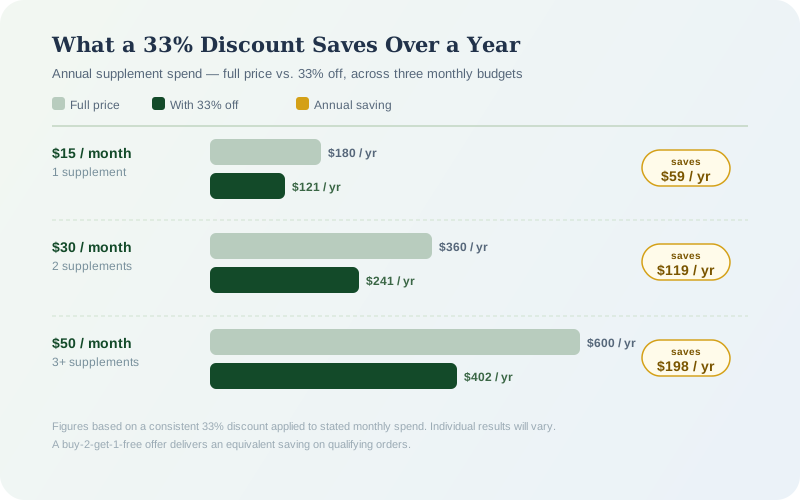
The math on buying vitamins in bulk or taking advantage of a supplement sale is simple when the routine is already in place. A 33% discount or a buy-2-get-1-free offer on a supplement you take daily reduces the annual cost meaningfully, and the savings are greater if the product is something you plan to keep taking long-term.
Beyond cost, stocking up also removes the problem of reordering gaps. Most people who take supplements regularly have experienced running out and delaying their next order for a week or two. For some supplements, that gap is minor. For others that support a consistent nutritional routine, maintaining supply continuity is part of the point. Buying supplements on sale with enough supply buffer tends to smooth that out.
Synevit is currently running a 33% off sale with a buy-2-get-1-free option across its product range, which is a good time to revisit supply levels for any formula already in rotation. If you have been meaning to add a second product alongside your current supplement, it may also be a good time to do that.
The supplement categories where bulk savings tend to be most noticeable are the ones people take daily over extended periods: vitamin D, B-complex formulas, iron, magnesium, and multivitamin products. High-volume, consistent use is where the economics of buying vitamins in bulk and discount vitamins and supplements pay off most clearly.
Storage and Quality When You Stock Up
Vitamin shelf life and storage are directly connected. Most vitamins and minerals are sensitive to the same environmental factors: excess heat, humidity, direct light, and prolonged oxygen exposure. A supplement stored correctly in a cool, dry cabinet may reach its labeled expiry date in good condition. The same supplement stored in a steamy bathroom or near a heat source may degrade faster regardless of what the label says.
Practical storage guidance for a larger-than-usual supplement supply is straightforward: keep products in their original sealed packaging, store in a pantry, drawer, or cabinet away from the stove, dishwasher, shower, and windows, and avoid refrigerating products that are not specifically labeled for refrigeration, since moisture from condensation may cause its own problems.
For blister-packed supplements, individual dose isolation is a built-in advantage during longer storage periods. Each dose stays sealed separately, so the quality of dose sixty is not affected by the environment that earlier doses were exposed to during opening. Third-party verification programs like the USP Dietary Supplements Verification Program offer an additional quality signal for shoppers who want confidence beyond the label. Synevit's article on blister packaging in pharmacy covers how that form factor affects potency and stability in more detail.
The bottom line on storage when buying supplements on sale: the savings are most meaningful when the product reaches its expiry date in good condition. Matching storage to labeled recommendations is the most reliable way to get there.
Key Takeaways
- Buying supplements on sale makes practical sense when the routine is already established and the quantity fits your realistic usage pace before the expiry date.
- The expiry date on most supplements reflects a potency guarantee under labeled storage conditions, not the same kind of safety cutoff that applies to food.
- Most vitamins and minerals may remain stable for one to two years when stored in a cool, dry, dark environment with packaging sealed.
- Blister-packed supplements may hold potency more reliably during longer storage periods because each dose stays sealed until use.
- The real savings from supplement deals show up most clearly for products already in daily use over an extended period.
Frequently Asked Questions
- Is it worth buying supplements in bulk?
It may be worth it when the supplement is already part of a consistent routine, the quantity fits your usage pace before the expiry date, and storage conditions are appropriate. For products you are still trying out, smaller quantities first are usually the better call.
- How long do vitamins last once you buy them?
Most vitamins and minerals may remain stable through their labeled expiry date when stored in cool, dry, dark conditions with packaging sealed. Opened bottles accessed repeatedly may have a shorter effective quality window than individually sealed blister-packed products.
- What should I check before buying supplements on sale?
Check the expiry date against how quickly you realistically go through that quantity, confirm the storage conditions you have available match what the label recommends, and make sure the product is one you are already using consistently.
- Do supplements become unsafe after the expiry date?
The expiry date on most supplements reflects a potency guarantee, not a food-spoilage safety cutoff. However, potency may decline after the labeled date, which is why buying quantities you may realistically use before that point is a practical guideline.