Rochester, New York, 11/23/25 - Nutrition forms the cornerstone of human health, providing the building blocks that sustain every cellular process from energy production to immune defense. Bodies exhibit remarkable self-sufficiency by synthesizing certain compounds internally, yet many essential nutrients remain entirely dependent on external sources like a healthy diet or targeted supplements. This divide between endogenous production and dietary necessity underscores the importance of understanding vitamin deficiency risks and required daily vitamins to maintain optimal function.
Understanding Essential Nutrients and Why They Matter
Essential nutrients encompass six core categories that bodies require for survival and thriving: carbohydrates, proteins, fats, vitamins, minerals, and water. These elements fuel energy pathways, repair tissues, and regulate metabolic reactions, with macronutrients providing bulk energy and structure while micronutrients handle precise regulatory roles. A healthy diet supplies most of these, yet the body synthesizes some internally, highlighting a critical distinction that informs strategies to avoid vitamin deficiency.
Macronutrients and micronutrients differ in quantity needed and sourcing, where bodies produce certain non-essential variants but rely entirely on intake for others. Research emphasizes that severe shortages lead to conditions like scurvy from lack of vitamin C or rickets from insufficient vitamin D, affecting systemic and oral health. Awareness of required daily vitamins empowers individuals to prioritize food sources that bridge these gaps effectively.
Historical dietary patterns show humans adapted to varied environments by consuming diverse foods, yet modern lifestyles often disrupt this balance, increasing reliance on supplements. Bodies cannot manufacture all required daily vitamins, making a nutrient-dense healthy diet indispensable for long-term wellness.
Evolutionary biology reveals why humans lost certain synthesis abilities, such as vitamin C production, which ancestors obtained abundantly from fruit-rich diets. This genetic trade-off conserved energy but heightened vulnerability in food-scarce scenarios. Contemporary food processing further strips nutrients, amplifying the need for conscious choices in daily meals.
Macronutrients: The Energy and Structure Providers
Macronutrients include carbohydrates, proteins, fats, and water, each serving foundational roles in bodily function. Carbohydrates break down into glucose for immediate energy, while proteins supply amino acids for tissue building and repair. Healthy fats contribute to cell membranes and hormone synthesis, and water facilitates all physiological processes.
Bodies synthesize some fatty acids and non-essential amino acids internally, but essential counterparts demand dietary input. For instance, omega-3 and omega-6 fatty acids support inflammation control and brain health, yet remain unsynthesizable. A healthy diet rich in these macronutrients prevents energy deficits and structural weaknesses.
Water, though recyclable to an extent, requires constant replenishment through hydration to maintain fluid balance. Integrating these into meals ensures bodies access the energy providers they need without synthetic over-reliance.
Complex carbohydrates from whole grains stabilize blood sugar longer than refined sugars, reducing fatigue risks. Protein quality matters equally, with complete sources like quinoa offering all essential amino acids in plant form. Balancing macronutrient ratios tailors energy sustainability to individual activity levels.
Micronutrients: The Vitamins and Minerals That Keep You Alive
Micronutrients, comprising vitamins and minerals, operate in trace amounts to catalyze reactions and fortify defenses. Vitamins act as coenzymes, antioxidants, or signaling molecules, while minerals bolster bone integrity and nerve transmission. Deficiencies in these micronutrients manifest in oral issues like enamel hypoplasia or systemic problems such as anemia.
Fat-soluble vitamins store in tissues, contrasting water-soluble ones that demand daily intake due to excretion. A study on vitamins' roles in oral health reveals that lower vitamin A intake impairs epithelial development and tooth formation, leading to periodontitis. Required daily vitamins like these underscore the need for consistent sourcing through a healthy diet.
Minerals divide into macrominerals and trace elements, with bodies recycling some but unable to produce others like zinc or iodine. Pediatric growth particularly hinges on micronutrients such as iron and folic acid for development. Balancing these prevents the silent risks associated with vitamin deficiency.
Bioavailability influences micronutrient uptake, where cooking methods or food pairings enhance absorption-pairing iron-rich spinach with vitamin C boosts utilization. Soil depletion in modern agriculture lowers mineral content in produce, prompting fortified foods as practical solutions. Tracking intake through apps demystifies meeting required daily vitamins without guesswork.
Nutrients Naturally Synthesized by the Body
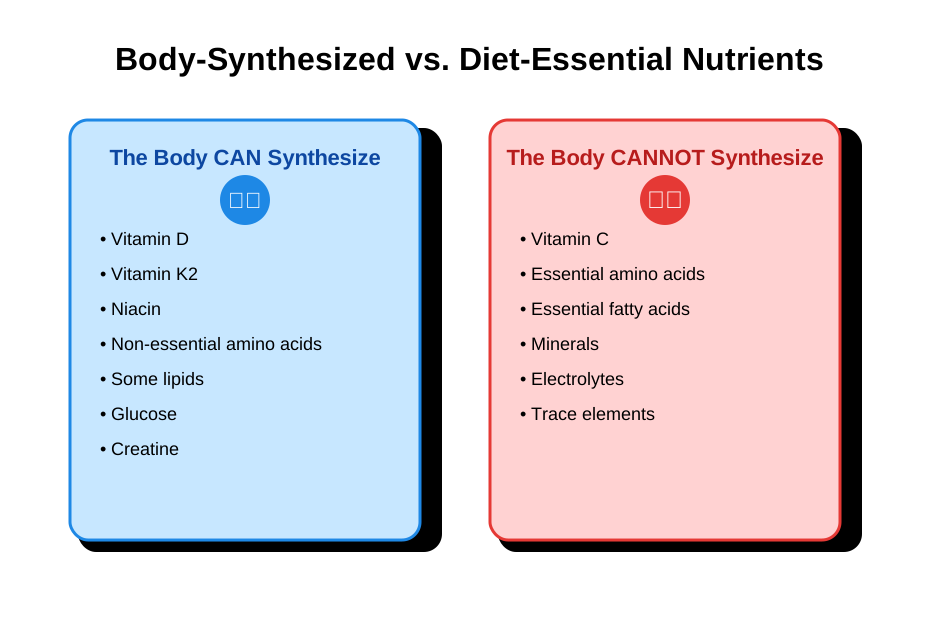
Bodies demonstrate ingenuity by producing certain nutrients endogenously, reducing dietary dependence for those compounds. Vitamin D emerges from skin exposure to UVB rays, supporting bone health and immune function, though limited sunlight often necessitates supplementation. Gut bacteria generate vitamin K2, aiding blood clotting and calcium utilization in bones.
Non-essential amino acids form through metabolic pathways from other compounds, and the liver synthesizes cholesterol for membrane integrity. Glucose arises via gluconeogenesis from proteins or fats during fasting, providing emergency energy. These internal mechanisms highlight bodily efficiency in nutrient management.
Niacin synthesizes from tryptophan in protein-rich foods, bridging diet and production. Products like Osteofect from Synevit complement such processes by enhancing bone-related nutrient absorption. Understanding these syntheses guides focus toward unsynthesizable elements in a healthy diet.
Microbiome diversity directly impacts vitamin K2 yields, where probiotic-rich fermented foods nurture beneficial bacteria. Sun exposure timing optimizes vitamin D conversion, with midday sessions proving most effective. These natural pathways evolve alongside lifestyle, adapting to environmental cues for nutrient equilibrium.
Essential Nutrients the Body Cannot Synthesize
Certain nutrients elude internal production, mandating intake to avert vitamin deficiency. Nine essential amino acids, including lysine and tryptophan, build proteins but require food sources like meats or legumes. Omega-3 and omega-6 fatty acids, vital for cardiovascular health, derive solely from fish, nuts, or seeds.
Vitamin C, absent in human synthesis due to evolutionary loss, prevents scurvy and supports collagen formation through citrus or peppers. B vitamins, except niacin from tryptophan, demand replenishment for energy metabolism and nerve health. Minerals such as iron for oxygen transport, iodine for thyroid function, and zinc for immunity remain diet-dependent.
Plant-free diets, as explored in carnivore contexts, raise concerns for these unsynthesizable micronutrients without careful planning. A healthy diet incorporating varied sources ensures coverage of required daily vitamins the body cannot produce.
Essential amino acid profiles vary by source, with animal proteins offering higher digestibility than plants. Omega-3 forms like DHA from algae suit vegan needs effectively. Cultural cuisines naturally combine these, as in Mediterranean diets rich in fish and greens for balanced intake.
The Role of Supplements in Modern Nutrition
Supplements address gaps where a healthy diet falls short, particularly for unsynthesizable nutrients. Vitamin D supplementation proves crucial in low-sunlight regions, while B12 aids vegans avoiding animal products. Quality choices, blending natural and synthetic forms, enhance bioavailability without excess.
Synergy in formulations like those from Synevit optimizes absorption. Strategic use prevents over-supplementation risks, especially with fat-soluble vitamins. Consulting professionals ensures supplements complement rather than replace food sources.
Carnivore diets may necessitate supplements for vitamin C or fiber equivalents to maintain balance. Integrating supplements supports required daily vitamins when dietary limitations arise.
Third-party testing verifies supplement purity, guarding against contaminants in unregulated markets. Timed dosing aligns with meals for better uptake, such as fat-soluble vitamins with oily foods. Personalized regimens evolve with age, addressing shifting synthesis capacities over lifetimes.
Common Deficiencies and How to Prevent Them
Vitamin D and B12 deficiencies prevail in modern populations due to indoor lifestyles and dietary restrictions. Iron shortages affect women through menstruation, leading to fatigue, while iodine gaps impair cognition. Testing reveals imbalances, allowing targeted corrections via diet or supplements.
A nutrient-rich healthy diet with leafy greens, nuts, and fortified foods counters these. Immune-focused options bolster defenses against deficiencies. Prevention emphasizes variety to cover all required daily vitamins.
Oral manifestations, such as gingivitis from vitamin C lack, signal broader issues. Regular monitoring and adjustments sustain health without vitamin deficiency complications.
Seasonal variations influence deficiency patterns, with winter amplifying vitamin D shortfalls in northern latitudes. Global fortification programs add iodine to salt, curbing goiter prevalence worldwide. Community education translates science into actionable meal plans for diverse populations.
Key Takeaways
- Bodies synthesize vitamin D, K2, non-essential amino acids, and cholesterol but cannot produce vitamin C, essential amino acids, or minerals like iron.
- A healthy diet prioritizes whole foods to supply required daily vitamins and prevent deficiencies.
- Supplements bridge gaps strategically, especially for unsynthesizable nutrients in restricted diets.
- Common deficiencies in vitamin D, B12, and iron arise from lifestyle factors and demand proactive management.
- Understanding synthesis limits empowers balanced nutrition for long-term vitality.
Frequently Asked Questions
- Which vitamins does the body make naturally?
Bodies produce vitamin D through sun-exposed skin and vitamin K2 via gut bacteria, with niacin forming from tryptophan. These reduce but do not eliminate dietary needs, as production varies by exposure and microbiome health. Supplements often enhance these for optimal levels.
- What nutrients do I need to take as supplements?
Unsynthesizeable nutrients like vitamin C, B12 for vegans, omega-3s, and minerals such as zinc require supplements when diets lack variety. Testing identifies specific gaps, guiding choices like multivitamins or targeted formulas. A healthy diet forms the base, with supplements filling precise shortages.
- Can I get all essential nutrients from food alone?
Diverse healthy diets supply most required daily vitamins, yet factors like soil depletion or absorption issues may necessitate supplements. Plant-based or restrictive eaters often need B12 or iron boosts. Balanced intake from multiple food groups typically covers needs without excess supplementation.
- Are natural supplements better than synthetic ones?
Natural supplements offer whole-food matrices that aid absorption, while synthetic versions provide standardized doses at lower costs. Both prove effective when quality-assured, with blends like Synevit's combining benefits. Individual bioavailability determines preference over blanket superiority claims.
- How do vitamin deficiencies affect oral health?
Deficiencies in vitamin A impair tooth formation and increase periodontitis risk, while vitamin C shortages cause gingival changes. B vitamins link to stomatitis and glossitis, underscoring micronutrient roles in epithelial integrity. Preventive healthy diets mitigate these oral manifestations effectively.
References
1. The Role of Vitamins in Oral Health Journal of Clinical Medicine
2. Macro and Micronutrients in Children's Growth Nutrients
3. Nutritional Adequacy of Plant-Free Diets Current Opinion in Clinical Nutrition and Metabolic Care