Rochester, New York, 5/26/26 - Vitamin D3 and K2 are often mentioned together, and the pairing reflects something real about how bone support works. D3 helps the body absorb calcium more effectively, but that step alone does not complete the picture. K2 plays a separate role in directing calcium toward bone tissue rather than allowing it to accumulate elsewhere. Add magnesium and zinc into the mix, and what looks like a long ingredient list starts to make practical sense as a coordinated system.
This piece covers what each of these nutrients does individually, why their combined action matters for bone density, and what the research suggests about how to increase bone density through consistent nutritional support.
Why D3 Alone Is Only Part of the Picture
Vitamin D3 has a documented role in calcium metabolism. The NIH Office of Dietary Supplements notes that vitamin D is essential for normal calcium absorption and that severe deficiency leads to inadequate calcium uptake from the gut. In practical terms, D3 raises the proportion of calcium that makes it from food and supplements into the bloodstream.
That is where K2 becomes relevant. More calcium in circulation is only useful if it reaches bone tissue rather than depositing somewhere else. Vitamin K2 activates two proteins that influence where calcium goes: osteocalcin, which is responsible for binding calcium into the bone mineral matrix, and Matrix Gla Protein (MGP), which is associated with keeping calcium from accumulating in soft tissue. The two nutrients cover different steps. D3 handles absorption; K2 handles what happens after absorption.
This is also the practical answer to a common question: do you need K2 with vitamin D? Not in the sense that D3 is ineffective without it, but in the sense that the combination addresses more of the bone support pathway. Someone using a D3-only supplement is covering the absorption step. Adding K2 covers the downstream step of directing that absorbed calcium into bone tissue rather than leaving it unguided in circulation.

What Vitamin K2 MK7 Does for Bone
Vitamin K2 comes in several forms, with MK4 and MK7 receiving the most research attention. MK7 (menaquinone-7) is found naturally in fermented foods, most notably natto, and in smaller amounts in certain cheeses. It draws particular interest because of its longer half-life in the bloodstream compared with MK4. Longer retention means the protein activation effect persists for a longer period after each dose rather than clearing quickly.
The NIH Office of Dietary Supplements vitamin K fact sheet notes that vitamin K functions as a cofactor for enzymes that activate specific proteins involved in bone metabolism and cardiovascular health. For bone, osteocalcin is the key protein. When properly activated by K2, osteocalcin may bind calcium more effectively into the bone mineral matrix that gives bone its structure and density over time.
Interest in K2 MK7 and bone density has grown steadily over the past decade, particularly in postmenopausal women where bone turnover tends to accelerate. The biological rationale is straightforward: a protein directly responsible for calcium incorporation into bone requires K2 to function. That mechanism gives the D3 and K2 pairing a clear scientific basis rather than a marketing one, and it is why the combination shows up in bone support formulas specifically rather than general vitamin blends.
Where Magnesium Fits In
Magnesium has two distinct connections to bone health. First, it is a structural component of bone mineral itself. The NIH Office of Dietary Supplements magnesium fact sheet states that approximately 50 to 60 percent of the body's total magnesium is stored in bone, where it contributes to the mineral composition that supports bone density. A prolonged shortfall in magnesium intake may affect that mineral balance over time.
Second, magnesium is required for the conversion of vitamin D into its biologically active form. Vitamin D goes through two hydroxylation steps before becoming calcitriol, the compound that drives calcium absorption. Both steps involve enzymes that depend on magnesium as a cofactor. This means that someone consistently supplementing with D3 but running low on magnesium may not get the full benefit from that D3, because the conversion process has a magnesium-dependent step upstream of the absorption effect.
The NIH also notes that dietary surveys consistently show many Americans consume less magnesium than recommended. Common food sources include leafy greens, legumes, nuts, seeds, and whole grains, but typical intake patterns often fall short of the daily recommended amount for adults. That shortfall is one reason magnesium is increasingly included in multi-ingredient bone support formulas alongside D3, K2, and calcium, rather than being treated as optional background nutrition.
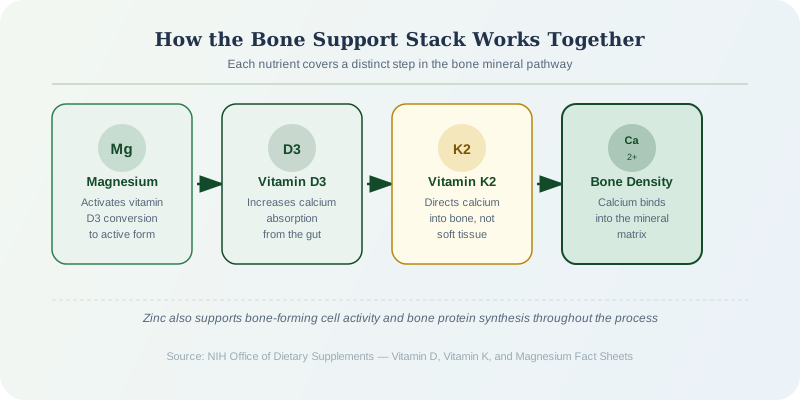
Zinc and Bone Metabolism
Zinc has a narrower but real role in the bone support picture. It is involved in the activity of bone-forming cells and in the synthesis of collagen and other proteins that contribute to bone tissue structure. The NIH notes that zinc is a component of many enzymes involved in bone metabolism and that deficiency is associated with impaired bone formation and growth. In the context of a bone support supplement, zinc is typically present at modest levels alongside the higher-volume nutrients, with its function focused on supporting the cellular processes that build and maintain bone over time rather than contributing to bone mineral directly.
For readers who want a broader look at how these nutritional factors interact with lifestyle and bone density over time, Synevit's guide on mild osteoporosis and bone health in women covers the full context, including how hormonal changes, exercise habits, and dietary calcium intake all factor into long-term bone maintenance.
What to Look For in a Bone Support Complex
Given that D3, K2, calcium, magnesium, and zinc each cover a different part of the bone support pathway, a formula that combines them may address more of the overall process than a single-ingredient product. When evaluating a multi-ingredient bone support supplement, the form of each nutrient is worth checking. For K2, the MK7 form has the longer half-life and is the more studied option for ongoing bone support. For magnesium, well-absorbed forms tend to be preferable to magnesium oxide, which is less bioavailable despite being commonly used in cheaper formulas.
Synevit's Osteofect is a bone support complex that brings vitamin D3, vitamin K2, calcium, magnesium, and zinc together in a single daily supplement. For people who already have some of these covered through diet or separate products, it is worth reviewing which parts of the stack remain open before adding a multi-ingredient formula. For those starting a bone support routine without existing supplementation, a combined product simplifies the process and removes the guesswork around pairing individual nutrients correctly.
Diet and physical activity remain the foundation. Weight-bearing exercise, consistent calcium intake through food, and adequate sunlight where practical all contribute to how well the body maintains bone density over time. Supplementation works best as a complement to those habits rather than a replacement for them. For a closer look at what sunlight actually contributes to vitamin D status across different seasons and geographic conditions, Synevit's sun exposure and vitamin D article is a useful companion read.
Key Takeaways
- Vitamin D3 improves calcium absorption from the gut; K2 activates the proteins that direct that calcium into bone tissue rather than elsewhere.
- Vitamin K2 MK7 activates osteocalcin and Matrix Gla Protein, two proteins directly involved in bone mineral metabolism and calcium routing.
- Magnesium supports D3 conversion to its active form and is itself a structural component of bone mineral, with 50 to 60 percent of total body magnesium stored in bone.
- Zinc contributes to bone-forming cell activity and bone protein synthesis, supporting the cellular side of bone maintenance.
- A multi-ingredient formula combining D3, K2, calcium, magnesium, and zinc may address more of the bone support pathway than individual supplements taken separately.
- Diet, weight-bearing activity, and consistent follow-up remain the foundation of any plan to maintain bone density over time.
Frequently Asked Questions
- Do you need K2 with vitamin D?
Not strictly required, but the combination covers more of the bone support pathway. D3 raises calcium absorption from the gut; K2 activates proteins that direct that calcium into bone tissue. Taking them together addresses both steps rather than just the first.
- How can you increase bone density through nutrition?
Consistent calcium intake through food, adequate vitamin D status, weight-bearing physical activity, and addressing gaps in magnesium and zinc are the main nutritional approaches. Supplementation may help where dietary intake falls short, and it works best alongside food and exercise habits rather than instead of them.
- What does vitamin K2 MK7 do for bone specifically?
MK7 activates osteocalcin, a protein that binds calcium into the bone mineral matrix. It also activates Matrix Gla Protein, which is associated with calcium regulation in soft tissue. The MK7 form is notable for a longer half-life in the body compared with other K2 forms, which makes it relevant for ongoing daily supplementation.
- What is the vitamin D3, K2, magnesium combination used for?
The combination targets several points in the bone mineral pathway. D3 improves calcium absorption, K2 directs calcium to bone tissue, and magnesium supports D3 conversion while also contributing directly to bone mineral composition. Together they may offer more complete bone support than any single nutrient alone.