Rochester, New York, 2/25/26 - Once you open a bottle with supplements, they start to lose their concentration due to oxidation process; by the time the bottle is finished, you might not get the labeled concentration therefore cutting short on the expected benefits. That is why product stability matters in practical, day-to-day terms. Heat, light, humidity, and oxygen may all influence how a formula behaves over time, especially for sensitive ingredients.
This is one reason why blister packaging has been part of the brand approach for years at SYNEVIT. The idea is simple: protect each dose until it is opened. This article takes an evidence-based look at stability, explains what published studies suggest, and shows why unit-dose blister packaging may be a sensible quality choice.
What Is Product Stability in Supplements?
Product stability describes whether a supplement would remain within its designated quality profile from the day of production through its expiry date. From a quality perspective, that usually means preserving strength, composition, and purity inside accepted ranges. If the profile shifts too far, users may not receive what the label originally represented.
In practical terms, stability is a full-system matter that is a result of formulation and ingredients interactions to packaging and storage. A high-quality formula may still lose performance if it is repeatedly exposed to moisture and oxygen during normal handling and storage.
What May Drive Supplement Degradation?
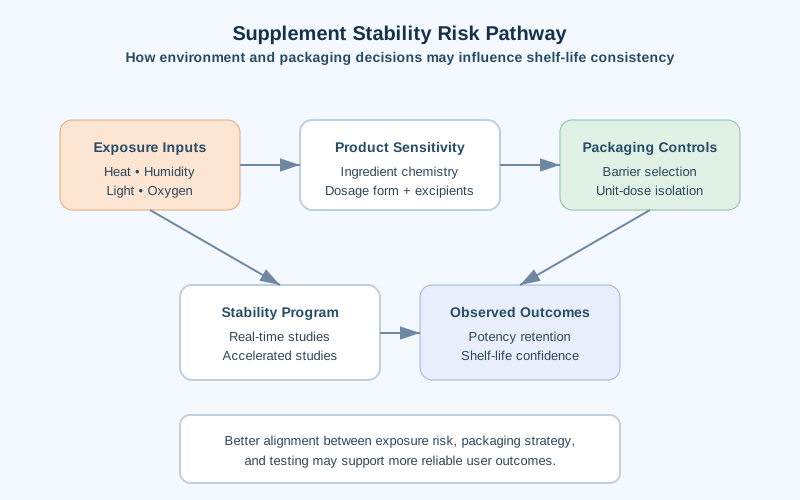
Four factors show up repeatedly in stability conversations: heat, humidity, light, and oxygen. Heat may speed reaction pathways. Humidity may increase hydrolysis risk. Light may affect photo-sensitive compounds. Oxygen may contribute to oxidative changes (degradation) in certain ingredients.
These effects are not identical across products. Sensitivity depends on ingredient chemistry, dosage form, tablet coating, and excipients. Because of that, stability planning would typically work best when it is product-specific rather than generic.

What Research Suggests About Stability and Packaging
Peer-reviewed literature supports the view that moisture control and package design may materially affect stability outcomes. One study found clear moisture-related effects linked to packaging configuration (PubMed: 11397566). More recent work also reports that environmental stressors such as temperature and humidity may influence vitamin stability over time (PubMed: 36411896).
Why Synevit Uses Blister Packaging
Synevit already uses blister packaging as a practical dose-protection strategy. In a multi-dose bottle, every opening may expose the remaining content to ambient air and humidity. In a blister format, only one dose is opened at a time while the rest stays sealed. That handling profile may support more consistent protection in real household use.
This does not mean every blister automatically outperforms every bottle in every case. Material selection, barrier performance, and validation still matter, and published modeling work shows why moisture ingress behavior can vary by blister design details (PubMed: 41012568). But as a quality philosophy, dose-level isolation aligns with a stability-first approach that values consistency over convenience-only packaging choices.
If you want a quick breakdown of how this works in practice, Synevit already explains the packaging model in What Is Blister Packaging in Pharmacy?, and expands on shelf-life implications in Synevit's Packaging Slows Down Supplement Degradation.
How to Evaluate Stability-Focused Supplement Quality
For consumers, three practical checks may help. First, prioritize brands that tie packaging to quality performance, not visual appeal alone. Second, check whether storage instructions are specific and clearly labeled on the packaging. Third, look for consistency: quality claim should extend to all products within the brand.
For producers, a straightforward sequence may work well: define sensitivity, choose packaging for expected exposure patterns, and verify with stability testing. That sequence is consistent with broader package-selection guidance focused on moisture protection for solid oral products (PubMed: 20845442) and may be more reliable than choosing a package format first and attempting to justify it later.
Storage Habits That May Support Stability
Even well-designed packaging would benefit from stable storage habits. Cool, dry, low-light settings are usually preferred over high-heat and high-humidity locations. Bathrooms and cars are typically less ideal due to frequent temperature and moisture swings.
It is also preferable to keep supplements in original packaging unless label guidance says otherwise. Packaging and usage instructions are usually developed together. In practice, storage discipline plus dose-protective packaging may support better shelf-life consistency.
Key Takeaways
- Supplement stability is a practical quality issue, not only a laboratory matter.
- Heat, humidity, light, and oxygen may all contribute to degradation pathways.
- Published NIH/PubMed-linked research supports packaging and moisture control as meaningful variables.
- Synevit's blister format reflects an existing dose-protection strategy for long-term consistency.
- Storage habits and packaging design would work best when treated as one system.
Frequently Asked Questions
- What does supplement stability mean for users?
It refers to whether a supplement would stay close to its intended quality characteristic through the labeled shelf-life period when used and stored as directed.
- Is blister packaging always better than bottle packaging?
Not always. Results depend on product sensitivity, barrier performance, and real-world handling conditions.
- Why does unit-dose packaging receive attention in stability work?
Because it may reduce repeated exposure of unopened doses to humidity and oxygen during everyday use.
- What home storage behavior may help?
Store supplements in a cool, dry place away from direct light and keep them in original packaging unless guidance states otherwise.
References
1. Packaging and moisture effects on pharmaceutical product stability (PubMed: 11397566)
2. Temperature and humidity impacts on vitamin stability (PubMed: 36411896)
3. Modeling moisture ingress in blister packaging (PubMed: 41012568)
4. Package selection for moisture protection in solid oral products (PubMed: 20845442)